Video Tape Formats We Transfer - VHS, VHS-C, Video8, Hi8, MiniDV and More
Not sure what tapes you have found? This guide covers every domestic video tape format, how to recognise each one, and how we transfer it to digital files or DVD. Mixed boxes are quoted and transferred as one job.
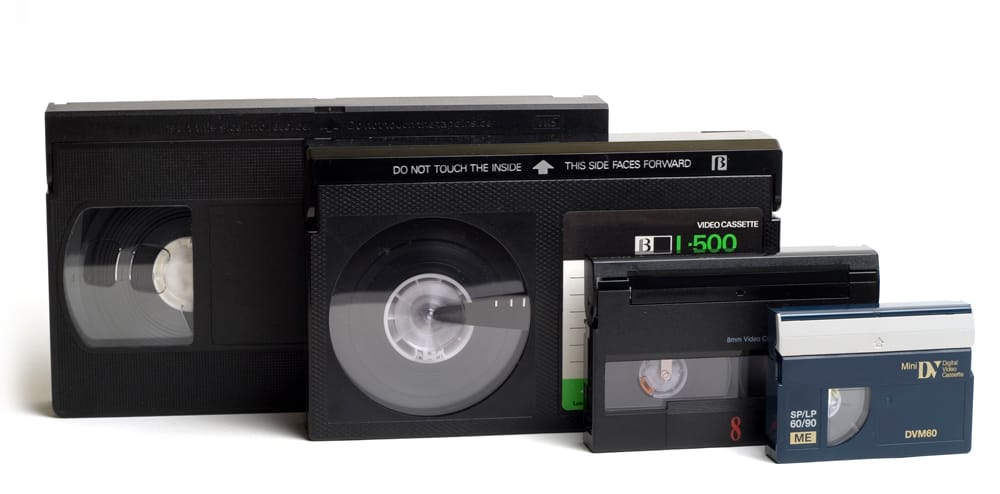
One box, every format, one job
Most people find a box of twenty or thirty mixed tapes in a loft: full-size VHS from the living room recorder, small camcorder cassettes from holidays, and perhaps a Betamax or two. Every format is transferred on the correct deck for that format, tapes are cleaned, and long-play recordings are handled without the stuttering you get from cheap converters.
Send the lot together. Mixed collections are quoted as one job and almost always work out cheaper than the per-tape list price. The main VHS to digital service page explains the process and what you get back.
- Full-length real-time transfer - nothing is sped up or trimmed
- MP4 files for sharing, ProRes masters on request
- USB stick, hard drive or DVD delivery
- Files named and dated to match your tape labels
VHS and S-VHS
The full-size cassette, about 19cm wide, used in home video recorders from the late 1970s to the 2000s. S-VHS looks identical but has a small hole on the underside and gives a sharper picture. Both are transferred on professional S-VHS decks through a time base corrector. Recordings made in long play (LP) are common and are handled without problems. Shop-bought films are covered on our pre-recorded VHS page.
VHS-C and S-VHS-C
A compact VHS cassette, roughly 9cm wide, used in full-size camcorders from the mid 1980s through the 1990s. It was designed to be played in a VHS recorder using a battery-powered adaptor. We transfer VHS-C directly, so worn adaptors and tired tapes are never forced through a domestic machine.
Video8 and Hi8
Small 8mm cassettes, about the size of an audio tape, used in Sony, Canon and other palm-sized camcorders from 1985 onwards. Hi8 is the higher-resolution version and is usually marked on the cassette. Both are analogue and are played on professional Sony decks with the signal stabilised before capture. Full details are on our 8mm and MiniDV page.
Digital8
The same 8mm shell as Hi8, but the recording is digital, so we capture it over FireWire with no quality loss. Digital8 camcorders could also play older Video8 and Hi8 tapes, which is why families often have all three in one box.
MiniDV, DV, DVCAM and HDV
The smallest cassettes, about 6.5cm wide, used from 1995 until memory cards took over. MiniDV and DV are standard definition, HDV is high definition and DVCAM is the professional version. All are captured digitally at full quality with the recorded date and timecode retained where present. Tapes from the same era on memory cards can be copied at the same time.
Betamax
Slightly smaller than a VHS cassette with a distinctive slanted corner, used in the late 1970s and 1980s. We keep working Betamax machines, so these tapes are transferred rather than turned away.
U-matic, Betacam and professional formats
Large U-matic cassettes and Betacam, Betacam SP, Digital Betacam and DVCPRO tapes come from schools, businesses and TV production. These are handled by our professional tape archive service on broadcast decks.
Still not sure what you have?
Take a photo of the cassette next to a ruler or a coin and send it to us. We will tell you exactly what it is, whether it can be transferred, and what it will cost. Damaged, mouldy or snapped tapes of any format are covered by our tape repair service.
Call 0207 430 1811 or email CopyMyTapes@gmail.com
Frequently asked questions
- How do I tell which video tape format I have?
- Size is the quickest guide: full-size VHS is about 19cm wide, VHS-C about 9cm, Video8, Hi8 and Digital8 about 9.5cm by 6cm, and MiniDV about 6.5cm wide. The format name is normally printed on the cassette shell or label. If in doubt, send us a photo.
- Can I send different tape formats in the same order?
- Yes. Mixed collections are the norm. Everything is logged, transferred on the correct deck and quoted as one job, which usually costs less per tape than sending formats separately.
- Do you transfer NTSC tapes from America or Japan?
- Yes. PAL, NTSC and SECAM tapes in every format are all handled.
- What does it cost to transfer a mixed box of tapes?
- Tapes start at £15 each for five or more, with single tapes from £25. Tell us the formats and roughly how many you have and we will send an exact price before any work starts.
Related pages
VHS to Digital Transfer Service - Convert Video Tapes Across the UK
Convert your VHS tapes to digital, along with every camcorder format - S-VHS, VHS-C, Video8, Hi8, Digital8, MiniDV, HDV, U-matic and Betamax. Delivered as MP4 files on USB, by download or on DVD, for customers anywhere in the UK.
Read moreVHS to DVD Transfer Service - Chaptered Discs You Can Play Anywhere
Convert your VHS, S-VHS and VHS-C tapes to DVD - authored with menus and chapters so they play on any DVD player - or add MP4 files on USB for your computer, phone and TV.
Read moreHi8, Mini DV, Digital 8 and VHS-C transferred to DVD or any file format
Small camcorder tapes need the right deck. We keep working Video8, Hi8, Digital8, MiniDV, DV, DVCAM and HDV machines so your footage transfers cleanly rather than glitching.
Read moreVideo Tapes to Any File Format - MP4, ProRes, MOV and DVD Explained
Every tape and cine film we transfer can be delivered in the file format you need - to share online, for your own editing projects, or simply to store safely on a computer or hard drive. This page explains the options so you can choose with confidence.
Read moreWe can fix your broken video tape
Snapped, chewed, jammed and mould-affected tapes are repaired by hand and then transferred straight to digital. If we cannot fix your tape, there is nothing to pay.
Read morePrice list
Guide prices for every service. Larger collections and mixed formats are quoted individually.
Read moreContact us
Send us a message, call 0207 430 1811 or email CopyMyTapes@gmail.com. We usually reply the same working day.
Read more